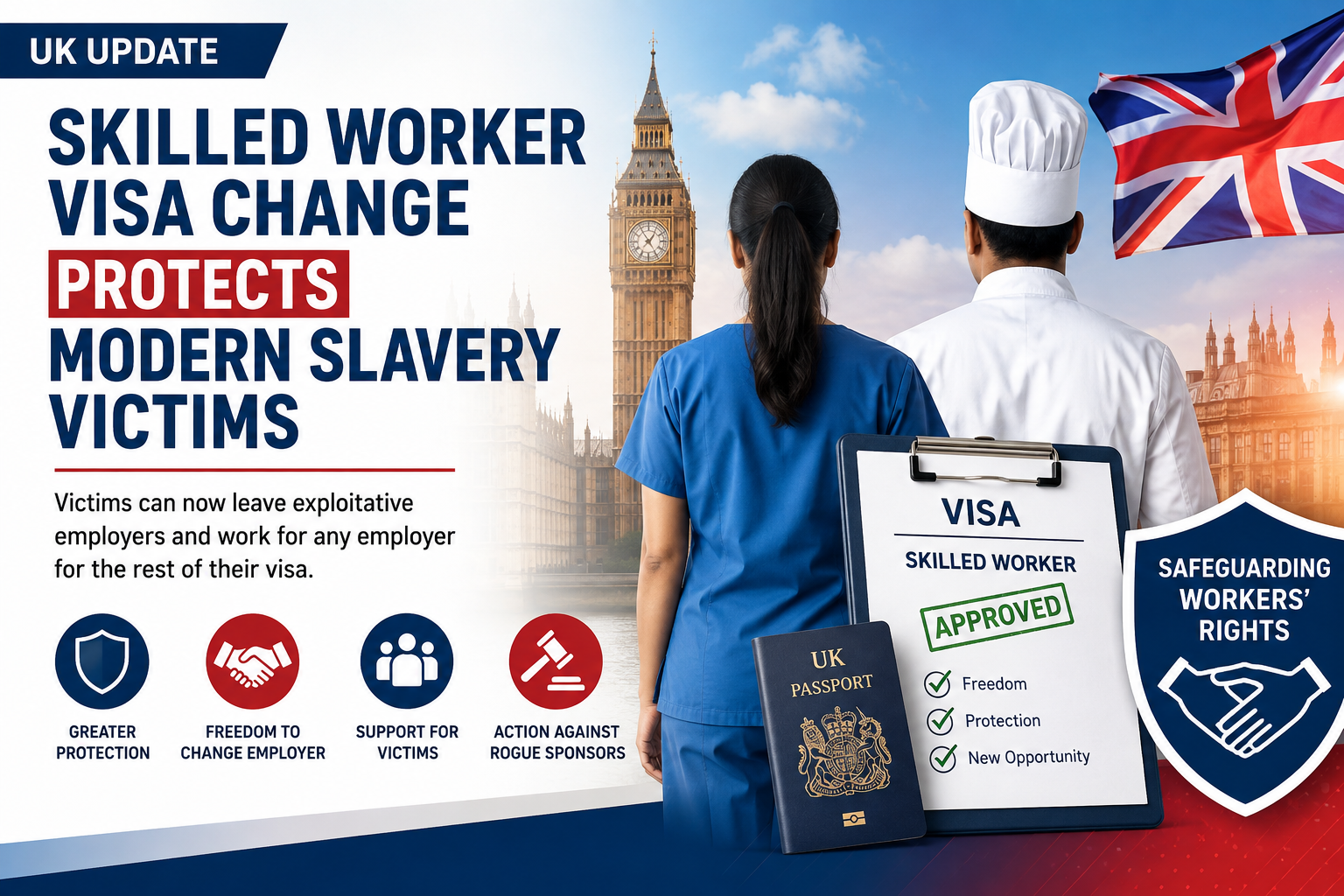
Modern slavery victims on UK Skilled Worker visas will be able to leave exploitative employers and work for another employer without being tied to their original sponsor for the rest of their existing visa.
The UK has introduced a significant change to its immigration rules aimed at protecting migrant workers who face exploitation at the hands of their sponsoring employers.
Under the new rules, a Skilled Worker who receives a positive conclusive grounds decision confirming that they are a victim of modern slavery can work for another employer for the remaining period of their existing immigration permission.
The change is particularly relevant to migrant care workers, hospitality employees, chefs and other sponsored workers whose immigration status has previously been closely linked to a specific employer.
What Has Changed For Skilled Worker Visa Holders?
The Skilled Worker route normally links a migrant’s permission to the sponsored job and employer specified in their immigration status.
That arrangement means changing employers generally requires the worker to update their visa before taking up the new role.
The UK Government has now introduced an exception for workers formally recognised as victims of modern slavery.
According to the “latest Immigration Rules changes” (https://www.gov.uk/government/publications/statement-of-changes-to-the-immigration-rules-hc-584-3-september-2026/explanatory-memorandum-to-the-statement-of-changes-in-immigration-rules-hc-584-3-september-2026-accessible), the restriction is being removed for eligible Skilled Workers who have been identified by the Home Office’s competent authorities as modern slavery victims. They can then work for any employer for the remaining duration of their existing permission.
Workers can check the general requirements for changing employment through the official “GOV.UK Skilled Worker visa guidance” (https://www.gov.uk/skilled-worker-visa/update-your-visa-if-you-change-job-or-employer).
Under the normal rules, a Skilled Worker who changes to a different employer generally needs to update their immigration permission. The official guidance explains when an application is required and what conditions apply.
Why is the Change Important?
Campaigners and organisations supporting migrant workers have argued that tying immigration permission to one sponsor can make vulnerable workers reluctant to report abuse.
A worker who fears losing their job and immigration status may feel trapped, particularly when they have paid significant costs to move to the UK and have limited access to public funds.
Reported forms of exploitation can include unpaid or withheld wages, excessive working hours, intimidation, deceptive employment arrangements and restrictions on a worker’s freedom.
The new measure is designed to reduce the leverage an abusive employer can gain from a worker’s immigration status.
The Government’s latest immigration-rule documentation sets out the policy change and its intended operation for eligible modern slavery victims.
How Does the Modern Slavery Process Fit in?
The protection is not automatically available simply because a worker believes they have experienced exploitation.
The worker must go through the UK’s “National Referral Mechanism (NRM)” (https://www.gov.uk/government/publications/human-trafficking-victims-referral-and-assessment-forms), the system used to identify and support potential victims of modern slavery and human trafficking.
A “conclusive grounds” decision is an important stage in that process. The competent authority assesses whether there are sufficient grounds to conclude that an individual is a victim.
The official NRM guidance explains the referral process, the organisations that can make referrals and the support available to potential victims.
What Happens After a Worker is Recognised as a Victim?
Once the relevant decision has been made, the new Skilled Worker protection allows an eligible worker to move away from the original sponsor and work for another employer during the remainder of their existing immigration permission.
This is a major difference from the normal Skilled Worker arrangement, where changing employer can require an immigration application or update.
The purpose is not to create a completely new visa. Instead, it removes the employer-specific work restriction for the remaining period of the worker’s current permission.
The change therefore gives recognised victims greater freedom to leave an abusive workplace without automatically losing their existing immigration permission.
Wider UK immigration reforms are also targeting exploitation
The change comes as the Government reviews the wider sponsorship system.
In its immigration white paper, the Government acknowledged concerns about international workers being exploited by some employers and discussed measures aimed at strengthening protections within the sponsored migration system.
The wider policy objective is to give migrant workers greater protection while improving accountability among employers.
For the latest official information, readers can also consult the “UK Immigration Rules” (https://www.gov.uk/guidance/immigration-rules), which are updated regularly as immigration policy changes.
What Does this Mean for Care Workers?
Care workers have been among the groups most closely associated with concerns about exploitation within the sponsored migration system.
The Government has already introduced major changes affecting overseas recruitment in the adult social care sector. The wider policy shift has reduced reliance on overseas recruitment while placing greater emphasis on protecting workers already in the UK.
For a migrant worker who has been formally recognised as a modern slavery victim, the new rule could provide an important route away from an abusive workplace without immediately losing the ability to work lawfully in Britain.
However, the protection depends on the worker receiving the relevant formal recognition. It should therefore not be interpreted as a blanket exemption for every worker who has a dispute with their employer.
Employers face Greater scrutiny
The changes also form part of a broader crackdown on employers that misuse the sponsorship system.
The Government has indicated that where evidence of criminal conduct is found, cases can be referred to law enforcement.
This puts greater pressure on licensed sponsors to comply with employment and immigration requirements and treat sponsored workers lawfully.
The wider message from ministers is that immigration sponsorship should not be used to control workers or prevent them from escaping abusive employment.
What should Skilled Worker migrants know?
The most important point is that a normal Skilled Worker visa is still generally connected to sponsored employment.
The new protection is specifically aimed at workers who have been formally identified as victims of modern slavery.
Anyone affected by exploitation should obtain appropriate professional advice and use official UK Government information before making decisions about employment or immigration status.
The “GOV.UK modern slavery guidance” (https://www.gov.uk/government/publications/human-trafficking-victims-referral-and-assessment-forms) provides official information about the National Referral Mechanism and the process for referring potential victims.
A significant shift in migrant worker protection
The rule change represents a notable shift in how the UK immigration system responds when sponsorship itself becomes part of an exploitation risk.
Previously, the connection between worker and sponsor could create an additional source of vulnerability. The new protection separates that connection for recognised modern slavery victims, allowing them to seek employment elsewhere while retaining their existing immigration permission for its remaining duration.
The Government says the measure is intended to help vulnerable workers leave abusive workplaces while allowing authorities to take action against employers responsible for exploitation.
For migrant workers, the practical impact will depend not only on the new immigration rule but also on how effectively victims can access the modern slavery identification and support system.
Key Takeaways
– Recognised modern slavery victims on the Skilled Worker route can work for another employer for the remainder of their existing visa.
– The protection applies after the relevant competent authority identifies the worker as a modern slavery victim.
– The change removes the normal employer-specific work restriction for eligible victims.
– The policy is intended to reduce the risk of immigration sponsorship being used to exploit migrant workers.
– Employers suspected of criminal exploitation may be referred to the police.
– The Government is also considering wider reforms to make movement between sponsors easier.
– Workers should check the latest information on GOV.UK before making immigration or employment decisions.